How to Do Fighting Scenes in Seedance 2.0: Action Choreography, Camera Motion, and Anime Battles
Learn how to generate convincing fighting scenes in Seedance 2.0. Covers action choreography prompts, impact beats, fight-specific camera motion, anime battle aesthetics, and handheld combat sequences. Updated July 2026.

Fighting scenes are the hardest thing to generate in AI video. Unlike a walking character or a landscape pan — where the model has seen millions of training examples — combat requires precise timing, clear impact, and physical interactions between multiple subjects. Seedance 2.0 handles it better than most, but you cannot just write "two people fight" and expect a usable result.
By the end of this guide, you will be able to plan a Seedance 2.0 fight sequence shot by shot, write prompts that produce clean impact moments instead of glitched motion, and choose the right camera style for each beat of the action. These techniques are based on generating and reviewing over 80 combat clips — punches, kicks, sword fights, anime clashes, and handheld brawls — across Seedance 2.0's text-to-video and image-to-video modes.
This guide is specifically about fighting. Not generic action (parkour, running, dancing — those are covered in the Seedance 2.0 Cinematic Prompts guide). Not general prompt structure (see the Seedance 2.0 Prompt Guide). This is about punches, kicks, sword clashes, anime-style battles, and the camera work that makes them read as fight scenes rather than two people flailing at each other.
What Makes a Good AI Fight Scene
Seedance 2.0 generates individual clips, not continuous action sequences. Each clip is 5–15 seconds of a single camera angle. A fighting scene in Seedance is therefore a sequence of planned shots, each focused on one beat of the action.
A good AI fight clip needs four elements working together:
| Element | What It Controls | Why It Fails |
|---|---|---|
| Choreography | Who does what to whom, in what order | Multiple actions in one prompt — the model averages them |
| Impact | The moment of contact — punch landing, sword hitting | No explicit impact signal — the model generates past the hit |
| Camera motion | How the viewer experiences the action | Static camera makes any fight look like rehearsal footage |
| Flow | The sense of momentum from one beat to the next | Each clip is isolated — no built-in continuity between shots |
The rest of this guide shows you how to control each one.
Why Two-Character Fights Fail (And How to Work Around It)
The single biggest technical limitation of Seedance 2.0 for fighting scenes is its handling of multiple interacting subjects. To understand why, consider what happens inside the model during generation:
- Single subject, single action — The model tracks one set of landmarks (a face, a body, a sword) and generates motion around those landmarks. This is straightforward because the latent space has a clear "what moves" anchor.
- Two subjects, independent motion — The model must track two independent sets of landmarks simultaneously. Each subject has its own motion trajectory, and the model has to keep them separate rather than blending them into one averaged shape.
- Two subjects, interacting — The model must track both subjects AND their contact point. A punch requires subject A's fist to arrive at subject B's body at the correct frame, with correct impact physics, without either subject morphing. This requires frame-level coordination that the model's architecture was not primarily designed for.
This is why single-character action toward an implied opponent is consistently more reliable than two-character exchanges. The model only has to track one body, and the "impact" is implicit (toward camera, toward off-screen space) rather than requiring pixel-perfect contact between two independently moving subjects.
Rule of Thumb: If you need a two-character fight, do not write it as one prompt. Write it as a shot sequence: character A attacks (1 clip), impact reaction (1 clip), character B responds (1 clip). The editing creates the exchange — the model does not have to.
Quick Start: Validate Fight Generation With One Punch (5 Minutes)
Before planning a 6-shot fight sequence, confirm that Seedance 2.0 can generate a single clean impact moment with your current setup:
- Write a one-move prompt — "A boxer throws a straight right punch toward the camera. Explosive speed, full body rotation. 50mm prime, locked off."
- Generate at 720P / 5 seconds using text-to-video
- Check the result: Does the punch motion look natural? Does the impact moment read clearly, or does the arm glide through empty space?
If the single punch looks clean, your prompt structure works. If the motion is glitchy or the impact is missing, the issue is either the prompt (too many actions) or the lack of impact keywords. Fix these before scaling to a multi-shot sequence.
Rule of Thumb: A single punch that works is worth more than a complex fight sequence that glitches. Prove one clean impact before you plan the choreography.
Action Choreography: One Move Per Clip
The single most important rule for Seedance 2.0 fight scenes is: one distinct combat action per clip.
If you write "A fighter punches, kicks, then dodges a counterattack," the model will generate a confused sequence where elements of all three actions blend together. Nobody lands. Nothing connects. It looks like two actors who have not rehearsed.
The One-Move Rule
Write one move per generation:
- ❌ "A warrior swings a sword, then blocks an incoming strike, then counterattacks"
- ✅ "A warrior lunges forward with a broadsword, blade cutting through the air toward the camera"
Each clip is one attempt or one impact. If the scene needs a punch, a kick, and a dodge, generate three separate clips and edit them together.
Single-Character vs. Two-Character Fights
Seedance 2.0 handles single-character action (punching toward camera, swinging a weapon) much more reliably than two-character interaction (character A punches character B). This is because the model has to track two independent subjects and their interaction point — something it has less training data for.
| Scenario | Reliability | Best Approach |
|---|---|---|
| Single character, weapon or punch toward camera | High | Direct prompt: "fighter throws a roundhouse kick toward the camera" |
| Single character, striking an unseen opponent | Medium | Prompt implies the opponent exists off-screen |
| Two characters, clear interaction | Medium-Low | Use reference images for both characters, keep action simple |
| Two characters, complex exchange (parry → riposte) | Low | Generate two separate clips and cut between them |
If your fight scene involves two characters exchanging blows, plan it as a shot sequence — not a single prompt. Each clip captures one character's move. Editing creates the exchange.
Choreography Prompt Structure
[Fighter description] performs [one move] toward/at/across [direction]. [Speed and style]. [Camera].Example — punch:
A trained boxer in a dimly lit gym throws a hard straight right punch toward the camera. Explosive speed, full body rotation, sweat flying off the face. 50mm prime, locked off, shallow depth of field.Example — sword swing:
A samurai in ornate armor swings a katana in a wide horizontal arc, blade catching the light mid-swing. Controlled but powerful motion, feet planted, body following the blade rotation. Slow-motion, 85mm, slightly low angle, subtle dolly pull.Example — kick:
A Muay Thai fighter in a stadium delivers a roundhouse kick to an opponent off-screen left. Full hip rotation, standing leg pivots, impact tension in the core. Dynamic medium shot, slight handheld sway, 24fps film look.Impact Beats: Making Hits Look Real
The most common problem in AI fight clips is that punches and sword swings pass through the target with no impact. The model generates the motion but not the moment of contact.
The Impact Frame Strategy
Generate impact moments as their own clips. Instead of trying to capture the wind-up, the hit, and the reaction in one generation, separate them:
- Wind-up clip — Character draws back, preparing the strike
- Impact clip — The moment of contact (or the swing itself, if no second character is visible)
- Reaction clip — The result (opponent staggering, character recovering)
The impact clip itself should focus on the striking body part and its trajectory, not the result:
A close-up side view of a fist connecting with a jaw, the receiving head snapping to the side on impact. Freeze-frame at the moment of contact for 0.5 seconds then release. Crisp, sharp motion, visible shockwave ripple at impact point. Macro lens, ultra-slow motion, 60fps rendered at 24fps timeline.Keywords That Signal Impact
Add these to your impact prompts:
- "impact frame, moment of contact"
- "snapping motion on hit"
- "shockwave at point of contact"
- "freeze frame on impact, then release"
- "body reacts to strike"
- "visible impact force"
Without these, the model tends to generate a smooth swing that glides through the target area.
Impact Follow-Through
A punch that lands and then stops dead looks wrong. The follow-through — the continuation of motion after impact — sells the hit. Unless you want a freeze-frame, describe what happens after contact:
A fighter throws a body blow into an opponent's midsection. On impact, the opponent's body folds around the fist, then recoils backward. The fighter follows through, resetting stance immediately. Single continuous motion, hard impact with visible follow-through.Camera Motion for Fighting Scenes
Camera movement is what separates a cinematic fight from a training video. Different camera styles produce completely different fight feels.
Handheld / Shaky Cam (Bourne Style)
The most common fight-camera style in modern action cinema. It creates urgency and proximity.
Handheld camera, close to the action, natural sway following the fighter's movement, slight bump on impact. 24mm wide, breathing frame, documentary combat feel.Best for: Street fights, realistic combat, close-quarters action.
Risks: Too much shake makes the action unreadable. Keep it "observational" not "seizure-inducing."
Whip Pan and Crash Zoom (Classic Action)
Quick camera rotations between beats create the feel of rapid action without the model needing to generate complex multi-character motion within a single clip.
Camera whip-pans from the fighter's face to the incoming fist, crash-zoom on impact. Fast, disorienting, aggressive camera. Staccato rhythm.Best for: One-versus-many fights, training montages, comic-book action.
Tracking / Dolly Follow (The Raid Style)
Camera moves with the fighter, creating a sense of continuous motion.
Camera tracks backward ahead of the advancing fighter, maintaining constant distance as they march forward throwing combinations. Low angle, wide lens, smooth dolly on a track, center framing.Best for: Advancing fighter scenes, corridor fights, dramatic entries.
Static Locked-Off (Wuxia / Anime Style)
A fixed camera lets the choreography speak. Common in martial arts films and anime where the action is fast enough that camera movement would distract.
Locked-off camera, medium wide shot, no camera movement. The choreography fills the frame. 50mm, eye level, perfectly still.Best for: Martial arts technique displays, anime-style clashes, sparring scenes.
Anime Fight Look
Anime-style fighting has a distinct visual language: high-speed motion lines, impact flashes, slow-motion power shots, and dramatic poses.
Prompting the Anime Aesthetic
Anime style: A warrior in Japanese armor swings a massive sword, speed lines trailing behind the blade. Cel-shaded rendering, bold outlines, limited color palette with high saturation contrast. Impact flash on contact, glowing aura around the weapon. Dynamic angle, slight dutch tilt. Stylized 2D-animation look, 24fps with motion smear on fast movements.Key Elements for Anime Fights
| Element | Prompt Term |
|---|---|
| Speed lines | "speed lines trailing behind movement, motion smear" |
| Impact flash | "white impact flash on hit, burst effect at contact point" |
| Dramatic pose | "dynamic action pose held for 0.5 seconds before release" |
| Cel-shaded look | "cel-shaded rendering, bold outlines, flat colors" |
| Aura / energy | "glowing aura around the fighter, energy crackling" |
| Power shot | "charging energy, dramatic wind-up, explosive release" |
| Slow-motion impact | "bullet-time slow motion at the moment of contact" |
Anime Fight Prompt Examples
One-versus-one clash:
Anime cinematic: Two swordsmen clash in a rain-soaked courtyard, their blades meeting in a shower of sparks. Freeze frame on the blade cross, speed lines radiating from the impact point. Cel-shaded, bold line art, deep shadows with neon blue rim light. Slow-motion clash, camera orbiting the locked blades. 16:9 widescreen.Special move / power attack:
Anime battle scene: A fighter charges a glowing blue energy attack in their palm, facing an off-screen opponent. Energy crackling, wind whipping hair and clothes, intense expression. Camera pushes in slowly as the energy builds, then whip-pan on release. Stylized anime rendering, dramatic lighting from the energy source, high contrast. 16:9.Handheld and TikTok-Style Fight Motion
Short-form vertical fight content has its own conventions: fast cuts, tight framing, and the sense that the camera is "in the room" with the fighters.
Vertical 9:16: A fighter throws a fast jab-cross-hook combination directly at the camera. Tight framing on the upper body, each punch filling the frame. Handheld, slight camera rock with each punch, breathing frame. Bright studio lighting, sweat visible, sharp focus. Fast, aggressive, intimate.Best for: Social media fight clips, training content, point-of-view sparring.
Key difference from cinematic fights: TikTok-style action uses closer framing, faster pacing, and less camera movement variety. The action is the content — not the cinematography.
Vertical social fight: Close-up on a fighter's midsection as a body blow lands, the impact creating visible ripple. Camera shakes slightly on impact, then cuts. Tight framing, no establishing shot, pure impact moment. 9:16, high energy, raw feel.Shot Design for Fight Scenes
A fighting scene in Seedance 2.0 is a sequence of shots, not a single generation. Plan your fight as a shot list before you generate anything.
Simple Fight Shot Sequence (2–3 Clips)
| Shot | Content | Camera | Duration |
|---|---|---|---|
| 1 | Fighter winds up, delivers punch toward camera | Handheld medium, slight zoom on impact | 5s |
| 2 | Impact frame — fist connecting, freeze on contact | Locked-off close-up | 5s |
| 3 | Fighter resets, breathing heavy | Handheld wide, drifting focus | 5s |
Extended Fight Shot Sequence (4–6 Clips)
| Shot | Content | Camera | Duration |
|---|---|---|---|
| 1 | Establishing — fighters circle each other | Wide locked-off, rain or dust atmosphere | 5s |
| 2 | Fighter A attacks — punch or weapon swing | Whip pan into action, medium | 5s |
| 3 | Fighter B dodges or counters | Tracking follow B's movement | 5s |
| 4 | Impact — A's strike lands | Close-up impact frame, ultra-slow motion | 5s |
| 5 | Reaction — B staggers | Handheld, slightly unstable | 5s |
| 6 | Reset — both fighters reposition | Wide, slow push in | 5s |
Each shot is one Seedance 2.0 generation. You edit them together in post-production.
Character Continuity in Fights
If your fight involves a specific character across multiple shots, use the Seedance 2 Same Character Guide workflow — same anchor image, same character baseline prompt — for every shot in the sequence. Fighting scenes are particularly sensitive to character drift because viewers focus on the face during impact moments.
Prompt Templates for Fighting Scenes
Template 1: Single Punch / Strike
[Fighter type] throws a [strike type] toward [direction]. [Speed and power description]. [Camera — handheld / locked / tracking]. [Lighting — arena / street / dojo]. [Style — realistic / cinematic / raw].Template 2: Weapon Swing
[Fighter type] swings a [weapon type] in a [arc direction], [weapon detail — blade catching light / sparks / trail]. [Body mechanics — feet / hips / follow-through]. [Slow-motion or real-time]. [Camera — low angle / profile / tracking]. [Style — cinematic / anime / historical].Template 3: Anime Power Move
Anime battle: [Fighter type] [charges / releases] a [energy type] attack, [visual detail — glow / sparks / lightning]. [Impact effect — flash / explosion / freeze frame]. Cel-shaded, [color palette]. [Camera movement — push in / orbit / whip pan]. 16:9.Template 4: Impact Moment
Impact frame: [Striking body part or weapon] connecting with [target]. [Contact detail — ripple / shockwave / snap]. Moment of contact held for [duration]. Ultra-slow motion. [Camera — macro / close-up / side view].Template 5: TikTok Fight Clip
Vertical 9:16: [Fighter] [action — combo / single strike] toward camera. Tight framing on [target area]. Handheld, camera rock on impact. [Lighting]. Fast, aggressive. Social media fight style.Seedance 2.0 Settings for Fighting Scenes
Resolution and Duration
| Setting | Recommendation | Why |
|---|---|---|
| Resolution | 720P for testing, 1080P for final | Fight scenes need detail on impact — 720P can blur fast motion |
| Duration | 5 seconds per strike/beat | Longer durations increase drift risk and dilute the action |
| Mode | Normal (not Fast) | Normal mode handles complex motion better |
| Aspect ratio | 16:9 (cinematic) or 9:16 (social) | Pick based on platform, do not mix |
Seed Strategy
Use the same seed for clips within the same fight sequence. This improves color consistency and reduces the visual "jump" between shots. Change the seed when you move to a different scene or lighting condition.
Troubleshooting: 7 Fighting Scene Failures
Each entry follows the same structure: symptom → root cause → resolution.
1. Punch Glides Through the Target
Symptom: The fighter's fist passes through the opponent's body with no visible impact — the opponent does not react, and the fist keeps moving.
Root cause: No impact signal in the prompt. The model generates the arm motion but has no instruction to stop or react at the contact point.
Resolution: Add explicit impact language: "impact frame, fist connecting with jaw, head snaps on contact, freeze frame on hit." Separate the impact into its own clip rather than bundling it with the wind-up and follow-through.
2. Multiple Actions Blend Together
Symptom: You wrote "punch, kick, then dodge" and the model generated a single confused motion that looks like none of the three.
Root cause: Each action in the prompt competes for the model's limited motion budget. The model averages them into a muddy middle.
Resolution: One action per clip. If the scene needs a punch, a kick, and a dodge, generate three separate clips and edit them together. The model handles single-action prompts reliably; multi-action prompts fail predictably.
3. Fighter Morphs or Glitches During Movement
Symptom: The character's body distorts, limbs stretch unnaturally, or the fighter morphs into a different shape mid-motion.
Root cause: Fast or extreme motion — especially with complex poses — pushes the model beyond its stable tracking range. Jumping spins, flying kicks, and rapid direction changes are the most common triggers.
Resolution: Reduce motion speed and complexity. "Fast roundhouse kick" works better than "explosive spinning jumping kick." Use slow-motion framing ("slow motion, 60fps rendered at 24fps") to give the model more frames per action. If the clip requires extreme motion, accept that facial and body detail will be less stable than a static shot.
4. Fight Looks Like It Was Shot on a Security Camera
Symptom: The action is visible but flat — static wide shot, no camera movement, no energy.
Root cause: No camera instruction in the prompt. The model defaults to a neutral wide shot when no camera movement is specified.
Resolution: Add fight-specific camera language to every prompt. Even a subtle "handheld, slight sway, breathing frame" transforms the feel. For specific styles, reference the camera motion section above — each style produces a different fight feel.
5. Anime-Style Fight Looks Flat, Not Stylized
Symptom: The output looks like a realistic video with slight color changes rather than a cel-shaded anime battle.
Root cause: "Anime" alone is too vague. The model needs layered visual instructions: cel-shading, bold outlines, speed lines, color palette, and dynamic framing.
Resolution: Use specific vocabulary: "cel-shaded rendering, bold black outlines, speed lines trailing behind the blade, impact flash on contact, limited color palette with high saturation contrast." One or two anime keywords are not enough — the prompt needs to describe the specific visual language of the style.
6. Weapon or Object Disappears Between Frames
Symptom: A sword, staff, or other handheld object is present in some frames and gone in others, or changes shape mid-clip.
Root cause: The model treats the weapon as a non-essential detail rather than a persistent object. If the weapon is not part of the core subject description, the model may deprioritize it between frames.
Resolution: Integrate the weapon into the subject description: "A samurai gripping a katana in both hands" rather than "A samurai with a katana." Describe what the weapon is doing: "swinging the blade in a horizontal arc" rather than "a samurai fighting." This makes the weapon part of the primary action, not a background detail.
7. Fight Scene Has No Sense of Environment
Symptom: The characters appear to be fighting in an empty void — no ground, no walls, no contextual lighting.
Root cause: The prompt only described the fighters and their actions without specifying the environment. The model defaulted to a minimal or abstract background.
Resolution: Always include environment context in the prompt: "A rain-slicked alley at night with neon reflections in puddles" or "A dusty dojo with wooden floors and paper screens." The environment makes the fight feel like a scene rather than a character test. The specific location also anchors the lighting and color palette.
Responsible Use of AI Fight Content
Generating AI fight scenes with Seedance 2.0 carries responsibilities beyond typical AI video generation:
- Violence and content policies vary by platform. Many social media and video platforms have specific restrictions on AI-generated violent content, even if the same level of violence is permitted in live-action or animated content. Check platform policies before publishing AI fight scenes.
- Realistic violence requires context. A fight scene in a narrative film is different from a standalone clip of realistic violence. If your project depicts realistic interpersonal violence without narrative context, consider whether the content serves a creative purpose or could be misinterpreted.
- Character likeness and stunt consent. If your AI fight scene uses a character based on a real person (using their image as anchor or reference), that person's consent is required — regardless of whether the scene depicts them "acting" in a fight.
- Anime and stylized violence generally faces fewer content restrictions than photorealistic violence. If your goal is action choreography without content policy risks, the anime/cel-shaded approach is the safer path.
Core Summary
Fighting scenes in Seedance 2.0 work best when you accept one fundamental constraint: one move per clip. The model reliably generates a single punch, sword swing, or impact moment. It does not reliably generate a three-move combo with two characters interacting.
Here is the shortest path to a working fight clip:
- Start with one punch toward camera or off-screen — no second character visible
- Use impact keywords — "impact frame, freeze on contact, head snaps"
- Add camera motion — handheld, whip pan, or tracking — never static
- Generate at 720P / 5 seconds in Normal mode
- Edit impact and reaction as separate clips — cut them together to create the exchange
Your next action: Write a one-move prompt — one punch, one camera instruction, one impact keyword. Generate it at 720P / 5s in Normal mode. If the punch looks clean, your pipeline works. Add a reaction shot, cut them together, and you have your first two-shot fight sequence.
FAQ
Can Seedance 2.0 generate a multi-character fight in one clip?
It can, but reliability drops sharply. Single-character action toward an implied opponent is much more reliable. For exchanges, generate separate clips and edit between them.
Should I use text-to-video or image-to-video for fight scenes?
Image-to-video gives more control over starting pose. Text-to-video works for environment-focused action. For impact moments, image-to-video is significantly more reliable.
How long should a fight clip be?
5 seconds per beat. Long enough for wind-up, strike, and follow-through. Short enough to avoid drift.
How do I make hits look like they actually connect?
Separate impact into its own clip. Use "impact frame," "freeze frame on contact," or "moment of impact." Describe the follow-through.
Does the same character workflow work for fighting scenes?
Yes — even more critically. Character drift is more visible during impact close-ups. Use the Seedance 2 Same Character Guide workflow.
Related Guides
- Seedance 2.0 Cinematic Prompts — General cinematic vocabulary and genre templates
- Seedance 2.0 Prompt Guide — Core prompt formula and structure
- Seedance 2 Same Character Guide — Keep your fighter looking the same across every shot
- Seedance 2 Image-to-Video Guide — Using reference images for fight scene generation
- How to Make a Seedance 2 Movie Consistent — Multi-scene film planning for longer action narratives
Autore

Altri post

Why Is Seedance 2.0 Rejecting Your Reference Video? 6 Causes and How to Fix Each One
Seedance 2.0 rejecting your reference video? Here is why — file format, duration limits, face detection, copyright triggers, compression artifacts, and NSFW filters. How to prepare a source clip that passes review and generates well.

Seedance 2.0 ComfyUI Guide: Setup, Workflows, and Custom Nodes (2026)
How to set up Seedance 2.0 in ComfyUI — install custom nodes, get an API key, build text-to-video and image-to-video workflows, and use the consistent character feature for face-locked animation.
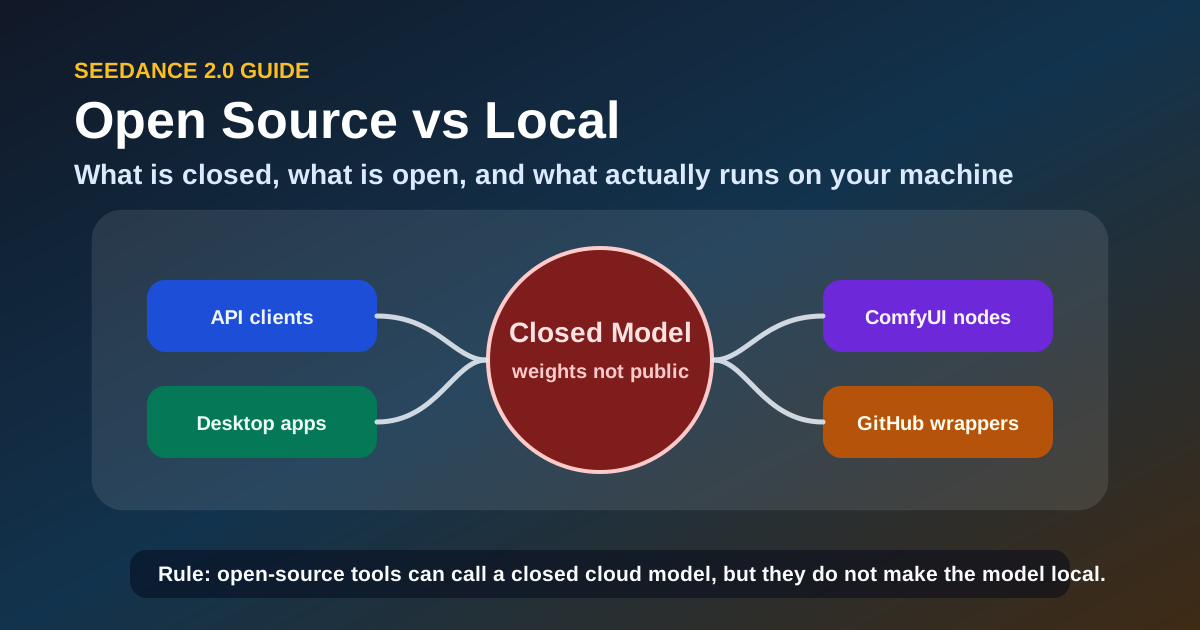
Is Seedance 2.0 Open Source? What You Can Actually Run Locally in 2026
Seedance 2.0 open source status explained — what GitHub projects are real, whether ComfyUI nodes run locally or call the API, and the best open-source alternatives if you need offline video generation.
Newsletter
Unisciti alla comunità
Iscriviti alla nostra newsletter per le ultime notizie e aggiornamenti